
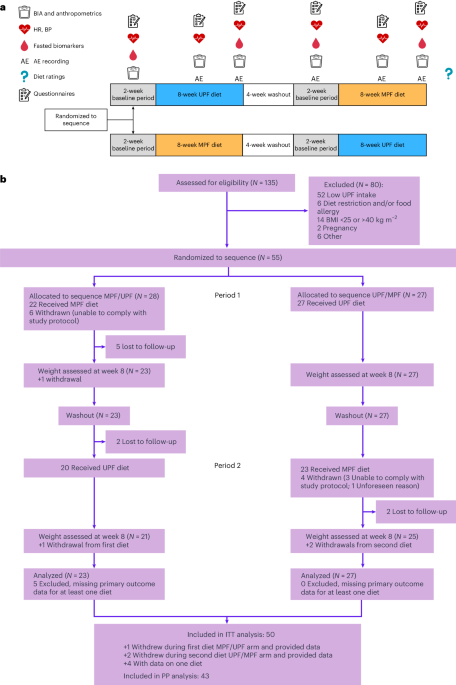
The trial protocol has been published previously22. Standard Protocol Items: Recommendations for Interventional Trials (SPIRIT) guidelines42 were used to design the protocol, and reporting was according to the Consolidated Standards of Reporting Trials (CONSORT)43.
Participants and setting
Fifty-five adults were recruited from South East England and London. Written informed consent was obtained before any screening or research-associated measurement. The last participant last visit was 13 October 2024.
Eligibility criteria
Inclusion criteria included any staff at University College London Hospital (UCLH), age ≥18 years, BMI between ≥25 kg m−2 and <40 kg m−2 (living with overweight or obesity), ≥50% kcal day−1 of habitual dietary intake consisting of UPF, weight stable (≤5% variation in weight in the last 3 months), medically safe to participate in a dietary intervention, able to read and write in English, willing and able to give written informed consent, able to comply with the study protocol and attend relevant inperson and online sessions and use of contraception until the end of the intervention period where necessary. Exclusion criteria included contraindication for a dietary intervention, participation in another clinical intervention trial, BMI > 40 kg m−2 or basal metabolic rate ≥2,300 kcal day−1 (to ensure intervention diets are at least 300 kcal day−1 greater than maintenance energy needs, based on excess energy intakes reported in ref. 20), diagnosis of type 2 diabetes or use of insulin, eating disorder, celiac disease or inflammatory bowel disease, any dietary restrictions (for example, vegan, vegetarian, Halal or kosher requirements, diagnosed food allergy or other allergy) that limit the ability to adhere to the dietary intervention, recent commencement of medications that cause weight gain or weight loss, a history of drug or alcohol abuse, pregnancy, breast-feeding or intention to become pregnant and any other factor making the participant unsuitable in the view of investigator.
Changes to protocol
On 16 June 2023, the UPF intake inclusion criterion was lowered from ≥60% to ≥50% to better reflect average UPF intake of prospective participants in South East England and London6. Participants were also asked to provide ratings of both diets after completion of the RCT (detailed below).
Randomization
Participants were block randomized by the research team using Sealed Envelope ( to either (1) the MPF diet then UPF diet (n = 28), or (2) the UPF diet then MPF diet (n = 27). Sealed Envelope generated the random allocation sequence. Randomization was stratified by nightshift status, sex and ethnicity. Researchers were not blind to assignment and enrolled participants. An independent statistician verified the primary outcome analysis while remaining blind to allocation assignment. Participants were not informed of the processing groups of the diets. All participant communications omitted the terms MPF or UPF, with diets being referred to as Diet A or Diet B.
Intervention
Participants were provided with an 8-week MPF diet and an 8-week UPF diet, both following EWG recommendations, in a random order, with a 4-week washout period. Participants were given all meals, snacks and drinks for both diets, which were delivered to participants’ homes twice per week. The Nova classification was used to classify food and drink into UPF and MPF5. The research team agreed on UPF items based on identifying ingredients of industrial use in product ingredient lists explicitly defining a product as UPF in published definitions (for example, cosmetic additives)5. Meals and snacks on the MPF diet were culinary preparations of individual ingredients (for example, raw meat, vegetables, oats, butter) ensuring correct Nova classification and no ambiguous decision on mixed dishes/shop-bought items.
Diets were matched for, and followed, government recommended nutrient intakes in the EWG15,16, which focuses on specific macronutrients and food types. Guidance includes choosing foods lower in saturated fat, added sugar and salt, consuming five daily portions of fruit and vegetables, basing meals on starchy carbohydrates and eating a variety of foods in the right proportions16 (Supplementary Table 24). To ensure ad libitum energy intake, diets were scaled up to approximately 4,000 kcal day−1. Menus were designed to be representative of UK diets by identifying the most commonly consumed food groups from the UK National Diet and Nutrition Survey41. Practical and logistical aspects including price, best-before dates, storage and preparation requirements, and accessibility were factored into the design44. Meals and snacks were matched across diets where possible, with a 7-day rotating menu to prevent participant boredom and sensory-specific satiety45. A patient and public involvement focus group provided feedback on the menu before the study. Menu guides were provided with instructions and pictures to prepare each meal. Supplementary Tables 24–26 report the average nutrient compositions of the provided diets, the menus and the images of meals and snacks on the menus, respectively.
As in previous ad libitum feeding trials investigating weight change46, participants were asked to consume as much or as little of the provided diets as desired. Participants were told to consume only the food and drink provided and to not consume any other food or drink, except water, during each 8-week diet. Tea and coffee were provided. Minor modifications to the intervention that did not alter the overall design were acceptable for enabling adherence (for example participants were allowed to add additional herbs and spices to meals but were not allowed to use any calorie- or salt-containing condiments). Alcohol was allowed but not provided. Participants were told to keep alcohol consumption within government guidelines (≤14 weekly units)47. Participants were educated on the EWG, but no further lifestyle guidance was provided (that is, no advice on physical activity, smoking or sleep). Participants were supported during each diet through weekly calls with the research team to discuss any issues and to promote adherence. Participants returned to their habitual diet during the 4-week washout period to minimize carryover effects. No food was provided during the 2-week baseline periods.
Procedures
Figure 1a outlines the study design and measurement timepoints. Age, sex, ethnicity, occupation, nightshift work pattern, educational level, marital status, medical history, medication intake, alcohol consumption, smoking habits and family history of obesity, cardiovascular disease and diabetes were self-reported at screening.
The baseline period lasted 2 weeks to allow time to collect all data to check eligibility, including regarding habitual UPF intake with two additional nonconsecutive recalls after screening, followed by randomization and booking in the baseline visit, and then sufficient notice and time to set participants up with their first food delivery. For consistency, a 2-week assessment window was used for the baseline visit of the second diet.
Weight was measured using an electronic scale to the nearest 0.1 kg (Tanita DC-430MAS; Tanita). Body composition, including fat mass, body fat percentage, visceral fat rating, fat-free mass, muscle mass, bone mass, total body water mass and total body water percentage were assessed using bioelectrical impedance analysis (BIA) (Tanita) at each visit. BIA at baseline and week 8 was conducted following an overnight fast with no alcohol intake or strenuous activity in the preceding 24 h. Assessments at week 4 were not fasted. Participants were provided with standardized wording in the week before their baseline and week 8 visits to maintain a consistent hydration status: “Please make sure that for the visit, you eat your usual diet for the 24 h before the visit day and to avoid alcohol and strenuous exercise. Please fast from 20:00 pm on the night before the study visit, and drink only water. Please do try to drink some water before the visit as this helps with the cannulation.ˮ Upon arrival, participants were asked to confirm that they had fasted and given the opportunity to drink water to thirst before measurements to ensure consistency. Basal metabolic rate was estimated by the Tanita BIA scanner based on fat-free mass and participant age. Height was assessed using a stadiometer to the nearest 0.5 cm. Waist circumference was measured in centimeters using an inelastic tape measure at the iliac crest48. BMI was derived from weight and height (in kg m−2), and waist-to-height ratio from WC and height. Estimated daily energy imbalance was assessed using the energy densities of fat mass and fat-free mass of ~9,300 kcal kg−1 and 1,100 kcal kg−1, respectively49. The mean daily energy imbalance (kcal day−1) for each participant for each diet was calculated as (9,300 × change in fat mass (kg) from baseline to week 8 + 1,100 × change in fat-free mass (kg) from baseline to week 8)/exact number of days from the start of the diet to the week 8 BIA assessment date. BP was recorded in triplicate, seated, alongside HR with an automated sphygmomanometer and oximeter. BP was recorded as the average of the second and third recordings. Venous blood samples were collected after an overnight fast and included glucose, HbA1c, liver function tests (bilirubin, alkaline phosphatase, alanine transaminase and albumin), lipids (total cholesterol, HDL-C, LDL-C, total-cholesterol-to-HDL ratio, non-HDL-C and triglycerides) and CRP.
CoEQ is a 21-item validated measure of the severity and type of food cravings that a person experiences, as well as of their inhibitory control of eating and subjective sensation of appetite and mood50. The CoEQ contains four domains: overall craving control, craving for sweet, craving for savory and positive mood and one question on perceived control over resisting a self-nominated craved food. PFS is a 15-item validated measure of hedonic appetite, food reward sensitivity and the psychological impact of living in food-abundant environments51. PFS assesses the appetite for and motivation to consume palatable foods at three levels: food available (but not physically present), food present (but not tasted) and food tasted (but not yet consumed)52. An overall PFS score is then computed from the mean of the three subscores. PFS and CoEQ were collected at baseline and at 4- and 8-week visits.
A 30-min meal test was used to assess acute changes in subjective appetite levels in the fasted and fed state at baseline and at 8 weeks. A five-item subjective appetite VAS was completed following an overnight fast. The questions capture aspects of hunger and the desire to eat: “How hungry do you feel right now?,ˮ “How sick do you feel right now?,ˮ “How much do you think you could eat right now?,ˮ “How full do you feel right now?ˮ and “How pleasant would it be to eat right now?,ˮ on a ten-point 100-mm scale, with words anchored at either end marking the extremes (“Not at allˮ and “Extremelyˮ)53. A liquid meal (187.5 ml Abbott Ensure (450 kcal, 17.5 g fat, 54.0 g carbohydrate, 19.1 g protein) was then consumed, and the subjective appetite VAS assessments were repeated at 15 and 30 min after starting the liquid meal.
Baseline habitual dietary intake was assessed using Intake24 (ref. 54)—a validated, online, self-reported 24-h recall system, based on a multiple-pass recall suitable for the general population (https://intake24.co.uk)55,56. Two nonconsecutive 24-h recalls were completed at screening, baseline and at week 4 and week 8 on each diet. Food diaries were provided to record adherence to the diets and report any foods consumed off diet. Nonadherence was prespecified as consuming more than one meal per week off the provided intervention diet. Participants were encouraged to report any deviations from the provided diets and to be as honest as possible, with no repercussions. All completed and returned food diaries were analyzed. The research team provided several options and opportunities for participants to return food diaries to maximize collection, including drop off at follow-up visits or at the research center at participants’ convenience during the trial. For any unreturned food diaries, participants were followed up several times to drop off food diaries at the research center at their convenience, post them at no cost or to email their food diary.
MVPA was measured objectively using wGT3X-BT (ActiGraph)—an accelerometer-based activity monitor providing information on body movement using a motion sensor. The device is a reliable tool and has been used widely in clinical research given its practicality, noninvasiveness, and accuracy in measuring physical activity levels in free-living adults57. Participants were instructed to wear the device on their dominant hip continuously for 7 days, to be removed only for water-based activities. Average daily MVPA is a validated measure obtained from hip-worn accelerometers58. For data to be valid, participants must wear the device for at least 4 days with at least 10 h of daily wear time. Wear time was validated in ActiGraph ActiLife software (v.6.13.6), based on the criteria in ref. 59. Thereafter, the cut points proposed by Freedson et al.58 were applied to each participant’s counts per minute data to derive the length of time spent in sedentary, light, moderate, vigorous and very vigorous physical activity to calculate average daily MVPA.
Following completion of the RCT, participants were asked to rate both diets on a scale of 0–10, with 0 indicating a negative, poor or bland experience, or the least intensity of the attribute being evaluated, and 10 indicating a positive, excellent or flavorful experience, or the greatest intensity of the attribute being evaluated. Ratings were of the overall experience, of meals and snacks, of flavors and taste, of textures, of portion sizes, of delivery and required preparation, of hunger level, of happiness/contentment and of diet sustainability. Further details on the ratings are provided in Supplementary Table 27.
Safety and AE monitoring
AEs were recorded by the clinical research team at baseline, at 4-week and 8-week study visits and from weekly phone calls. The assessment of the relationship of an AE with the intervention was carried out by the clinical research team. AEs were considered related if the causal relationship between the intervention and an AE was at least a reasonable possibility, that is, the relationship could not be ruled out. Reporting of AEs and serious AEs was conducted according to the Sponsor’s standard operating procedures, and updates on AEs were reported to the Trial Steering Committee and Trial Management Group. All SAEs were reported to the Sponsor within 24 h of the clinical research team becoming aware. A Data and Safety Monitoring Committee was not set up as no SAEs or notable risks were expected from participation. Incidental findings were reported to participants and their general practitioner as per written informed consent.
Outcomes
The primary outcome was the within-participant difference in %WC between MPF and UPF diets at 8 weeks from baseline. %WC is currently used clinically in weight management clinics and across all NHS weight management programs.
Prespecified secondary outcomes include changes in weight, waist circumference, BMI, body fat percentage, fat mass, fat-free mass, visceral fat rating, muscle mass, bone mass, total body water mass, total body water percentage, HR, SBP, DBP, blood markers (HbA1c, glucose, liver function tests, lipids and CRP), PFS (food available, food present, food tasted and total score), CoEQ (overall craving control, craving for sweet, craving for savory, positive mood, perceived control over resisting a self-nominated craved food), fasted and fed changes in the five-item subjective appetite VAS, dietary intake and average daily MVPA. Secondary outcomes of brain magnetic resonance imaging functional resting-state connectivity, physical function, sleep quality, mental health, quality of life and metabolomics, and results from the follow-up 6-month behavioral support program22 will be reported separately.
Nonprespecified outcomes included AEs, changes in waist-to-height ratio, estimated daily energy imbalance and differences in post hoc ratings of each diet.
Power calculation and sample size
The sample size is based on estimated within-participant variation22. The expected weight loss trajectory over 8 weeks was modeled using the National Institutes of Health bodyweight planner34 ( and based on data from Hall et al. showing 0.9 kg weight loss following a 2-week MPF diet20, with a s.d. of the mean difference in weight change between MPF and UPF diets of 1.98 kg (mean, 1.85 kg). In total, 44 participants were required to detect a mean difference of 2.7% WC between groups, assuming weight loss on the MPF diet and no WC on the UPF diet, with a s.d. of the mean difference of 5.4% (power, 0.9; alpha, 0.05; two-sided paired t-test, SPSS v.27.0). The final sample size was 55, factoring for a 20% dropout rate.
Normally distributed variables were reported using means and s.e., and non-normally distributed variables reported using medians and interquartile ranges. Categorical variables were described using frequencies and percentages, and analyzed using χ2 tests or Fisher’s exact tests where appropriate. Values are presented by randomization group and analyzed as randomized.
The primary outcome analysis was prespecified as an ITT analysis, with all available data being analyzed as randomized. Any participants were included regardless of dropout status if follow-up data on the primary outcome was observed. To use all available data, any participants withdrawing from the trial were included in the ITT analysis if they provided follow-up primary outcome data for at least one of the diet interventions (that is, the minimum data required to contribute to the primary analysis). This includes participants who dropped out after completing the first-period 8-week assessment (use of the first-period data only), or participants who dropped out in the first or second period before the 8-week assessment and agreed to attend 8-week follow-up assessments for measurement of weight (use of the first- and second-period data).
The ITT analysis included participants with baseline and week 8 primary outcome values for at least one diet. The PP analysis included participants with baseline and week 8 values for both diets, and no withdrawal.
Statistical analysis
Primary analysis
Mixed-effects models were used in an ITT analysis to assess the difference in %WC at 8 weeks and secondary outcomes, with a random effect for participants, and adjusting for randomization arm (including interaction with diet) and nightshift status. The primary outcome effect size with 95% CIs was then computed from the mixed-effects model using Cohen’s d60.
Initially, an interaction term was included in the primary outcome analysis mixed-effects model between the treatment (UPF or MPF diet) and the randomization arm (MPF/UPF or UPF/MPF) to assess any potential treatment-by-period or carryover effect. This interaction was significant (P < 0.001) and included in the mixed-effects models to account for the diet order/sequence.
The criteria used for selecting potential adjustment covariates for the mixed-effects model were prespecified in the protocol. These were defined as the randomization stratification variables (sex, ethnicity and nightshift status selected a priori based on the literature61,62,63), as well as any baseline participant variables that were not balanced between randomization arms.
Each potential participant baseline adjustment confounder identified from the prespecified criteria was added to the base mixed-effects model (the effect of diet adjusted for randomization arm, with an interaction term for diet and randomization arm and a random effect for participant). The significance of each confounder and the impact on the ITT primary outcome analysis effect estimate was assessed to determine inclusion in the final model (see Supplementary Table 23 for the model adjustment results). In this respect, sex, ethnicity and estimated baseline BMR were each individually not significant predictors of %WC in the mixed-effects model and did not alter the effect estimate of the ITT primary outcome analysis (see Supplementary Table 23 for the model adjustment results). These potential confounders were therefore not included in the final model. In contrast, nightshift status, when added individually, to the based mixed-effects model was a significant predictor of %WC.
Mixed-effects model assumptions including normality of residuals and homoscedasticity were checked visually and verified.
Sensitivity analyses
Unadjusted analyses of primary and secondary outcomes at 8 weeks were compared with baseline, and differences in changes from baseline to 8 weeks between diets were assessed using paired t-tests. Analyses were repeated for changes in outcomes at week 4 from baseline between diets, for changes at week 4 and week 8 from baseline between diets using repeated-measures mixed-effects models, for the PP sample, and for results using data from the first period of each randomization arm only. Carryover effects were not assessed as it is not possible to identify a carryover effect or adjust for it in a 2 × 2 crossover design43. No interim analysis was planned or conducted.
The impact of missing data on the primary outcome analysis was assessed using multiple imputation with chained equations under the assumption of data missing at random. Missing data for the primary outcome were first imputed using model variables (diet, randomization arm, nightshift status and available data for %WC), and then imputed using model variables and auxiliary baseline variables (diet, randomization arm, nightshift status, available data for %WC, ethnicity, sex, occupation, education, family history of obesity, baseline estimated BMR, baseline energy intake and baseline weight). The impact of missing data on the primary outcome analysis was also assessed using inverse probability weighting. Propensity scores for receiving the treatment (MPF diet or UPF diet) were first calculated using the randomization stratification variables: sex, ethnicity and nightshift status, and baseline estimated BMR, and then calculated using randomization stratification variables and auxiliary baseline variables (randomization arm, nightshift status, available data for %WC, ethnicity, sex, occupation, education, family history of obesity, baseline estimated BMR, baseline energy intake and baseline weight). Stabilized weights were then used to reweight the remaining sample.
Analyses were conducted in R v.2024.04.1+748. Data were presented in tabular form using Microsoft Excel v.16.91 (24111020), figures were created using Prism 10 v.10.2.3. Statistical significance was set at P < 0.05. As secondary outcomes in this study are exploratory in nature, significance values were not adjusted for multiple comparisons. Any apparent significance of these results should be confirmed in future research.
Ethics
The Yorkshire and The Humber–Sheffield Research Ethics Committee approved the trial on 22 December 2022 (22/YH/0281). The study was registered prospectively on ClinicalTrials.gov (NCT05627570). All participants provided written informed consent before any screening or research-associated measurement.
Patient and public involvement
NHS staff at UCLH provided input to the trial design following a focus group session. Obesity Empowerment Network UK members with lived experience of obesity also contributed to the study design. One member of the trial steering committee was a lay person. Participants could consent to a lay summary of the trial results.
Reporting summary
Further information on research design is available in the Nature Portfolio Reporting Summary linked to this article.
link