
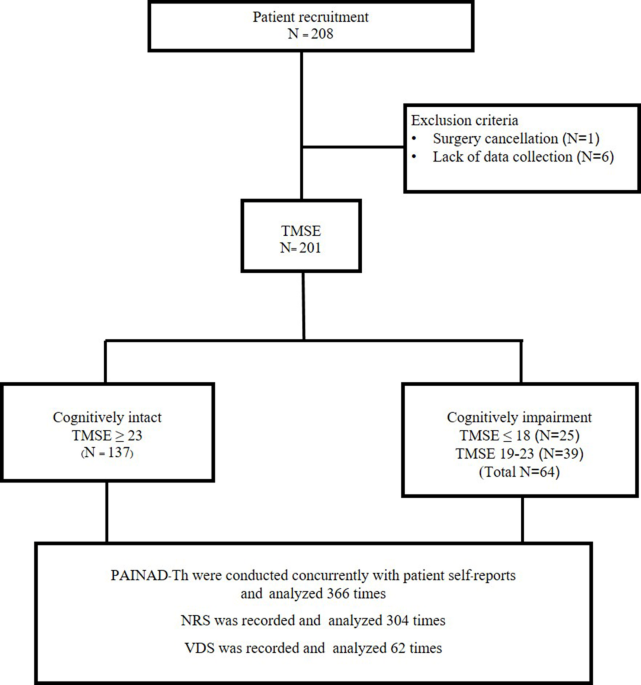
Our study evaluated the concurrent validity of the PAINAD-Th observational pain assessment scale against patient self-reports (NRS or VDS) in the postoperative management of geriatric patients. We found a remarkably strong correlation between the PAINAD-Th and VDS scores in both mildly to moderately cognitively impaired and cognitively intact individuals. Conversely, the PAINAD-Th/NRS correlation, though moderate across the full patient sample, was only fair in those with severe cognitive impairment. This result likely reflects these patients’ reduced capacity to utilize the NRS reliably. Our findings are consistent with previous work demonstrating limited NRS validity in advanced dementia patients, contrasting with the better validity of alternative behavioral tools, such as the Face, Legs, Activity, Cry, and Consolability scale26. Similarly Lautenbacher S and Kunz M27 support the notion that facial behavior, which is also a component of the PAINAD-Th, remains a sensitive indicator of pain in patients with dementia, especially when self-report is limited.
A notable observation was the greater discrepancy between the NRS and PAINAD-Th scores in cognitively intact patients. This might be attributed to their verbal expressiveness, potentially leading to less reliance on nonverbal pain behaviors (e.g., consolability or negative vocalization) captured by the PAINAD. Our findings support previous work suggesting a link between PAINAD scores and probable pain behaviors rather than a direct correlation with pain intensity16. Nonetheless, after applying Youden’s J statistic, we propose a PAINAD-Th cutoff score of 3 as a strong indicator of moderate to severe pain.
Sole reliance on self-reports has proven insufficient for pain assessment in older adults. Patients with suspected dementia or cognitive decline are particularly at risk of undertreatment, even when they report pain9,11. The integration of observational tools for this population is vital for providing healthcare professionals with the evidence they need to initiate effective pain management9.
Geriatric pain assessment involves inherent complexities stemming from pain misperceptions, communicative barriers, and cognitive limitations6. While the NRS is the gold standard, its utility is limited, particularly in cognitively impaired patients. Alternative self-report tools (e.g., the Visual Analog Scale or Faces Pain Scale) offer potential benefits. However, their reliance on visual and auditory capabilities presents challenges for geriatric patients, who often experience sensory decline. Furthermore, surgery and anesthesia exacerbate the risk of postoperative cognitive decline in geriatric patients. The significant incidence of postoperative delirium (15–53% in surgical patients, and up to 87% in the intensive care unit) further complicates pain assessment17. Given the strong interplay between pain and delirium, inadequate pain management increases delirium risk6,8,17which in turn impedes pain reporting and treatment.
Effective pain management strategies emphasize the importance of regular assessment and prompt intervention. A crucial component is the need to consistently administer protocol-driven analgesic treatments for rapid and sufficient pain relief. A validated, reliable, and user-friendly pain assessment tool specifically geared toward older patients with potential self-reporting limitations would considerably enhance this process. Such an instrument facilitates accurate assessment, ongoing monitoring, and clear communication among healthcare providers.
Our study underscores a concerning gap between pain reporting and treatment. Despite protocols for administering analgesia based on moderate to severe pain scores, only a quarter to half of our patients received the indicated medication. These findings align with previous research highlighting inadequate pain management and a reluctance to provide analgesia in older patients10,11,28. The American Geriatric Society guidelines underscore the necessity of supplementary pain assessment tools, such as behavioral observation, when cognitive status restricts the use of self-reports. The PAINAD scale has demonstrated utility for various patients with pain expression limitations, including those with dementia and patients in postoperative settings who may be unable to self-report13,29. However, evidence for suitable assessment tools in the context of postoperative cognitive dysfunction or delirium remains inconclusive8,29. Notably, one study showed that, compared with self-reports alone, PAINAD-guided assessments of cognitively impaired patients correlated with significantly greater opioid consumption without increasing adverse effects (e.g., respiratory depression or nausea)30.
Previous work demonstrates PAINAD’s feasibility in postoperative settings. This is supported by findings that 1-minute and 5-minute observation periods yield comparable effectiveness when assessing pain26. However, as an observational tool, the PAINAD-Th interpretation relies on healthcare provider experience and knowledge. Our study reinforces its potential utility in the postoperative management of geriatric patients. Since pain and delirium can develop or persist throughout hospitalization, regular assessment of both aspects is crucial for effective management.
While self-report remains the preferred method for pain assessment when feasible, alternative tools like the PAINAD are essential for patients with advanced dementia or other conditions severely limiting communication. The choice of method must be tailored to the patient’s current cognitive function and communication abilities, which can be affected by postoperative factors such as delirium. Our study supports using the PAINAD-Th postoperatively in those unable to self-report pain. Importantly, a PAINAD-Th score of ≥ 3 indicates moderate to severe pain, signifying the need for analgesic intervention or further pain management.
Limitations
Our study did not investigate the potential influence of chronic pain history on pain behaviors. Although PAINAD has been validated for both acute and chronic pain15 incorporating patient history remains an important component of comprehensive pain assessment. While the use of the PAINAD-Th to guide treatment and assess medication effectiveness has proven valuable, our sample of patients receiving pain interventions was small. Furthermore, we did not formally assess postoperative cognitive dysfunction or delirium (using tools such as the Montreal Cognitive Assessment or the Diagnostic and Statistical Manual of Mental Disorders, Fifth Edition, criteria). Therefore, clinicians must exercise caution when administering the PAINAD-Th in patients with suspected postoperative cognitive impairment.
link