
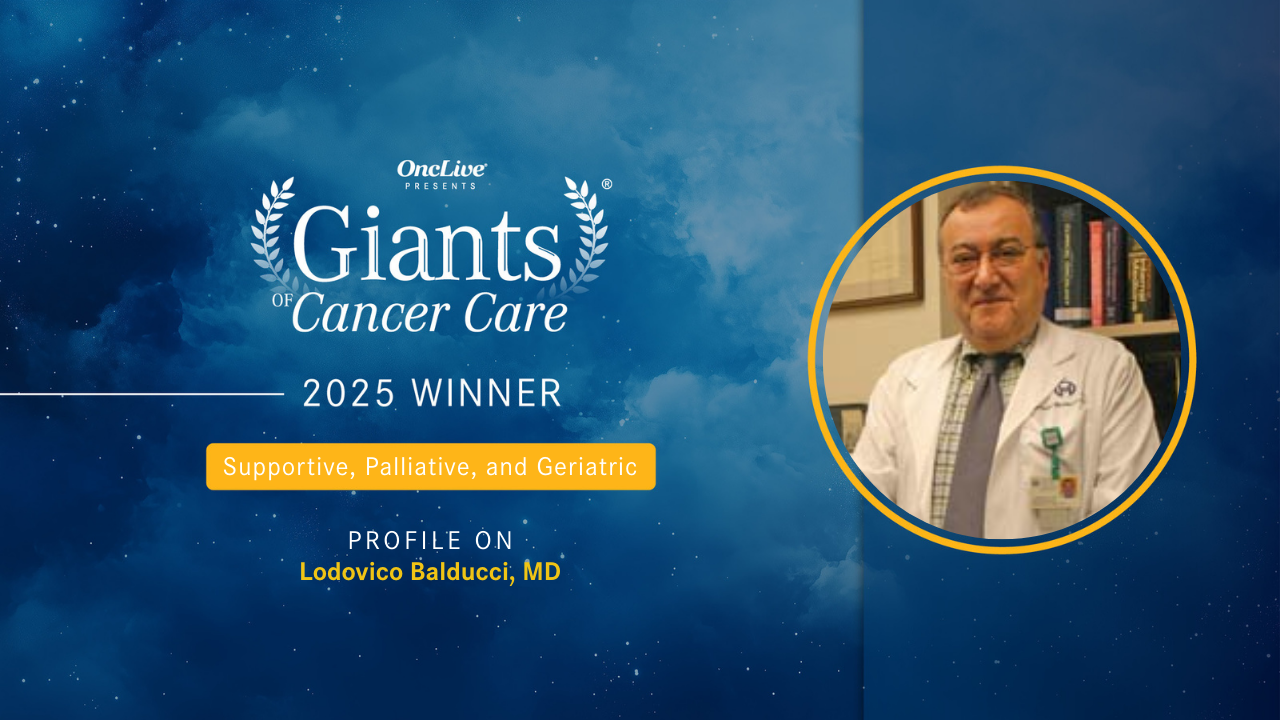
To most, holding a title like “The Father of Geriatric Oncology” might be daunting. However, Lodovico Balducci, MD, humbly accepts the nickname.
Balducci, the 2025 Giants of Cancer Care Supportive, Palliative, and/or Geriatric Care inductee, broke into geriatric oncology by defining the differences between chronological and physiological age. By doing that, he and his team were able to determine life expectancy through specific measures, such as the ability to perform daily living activities.
Throughout his career, beginning in Rome, Italy, and all the way to the US, Balducci carried the motivation and drive to pursue an unknown field and develop it into a fruitful area of research. While building his career in geriatric oncology, he could not know that one day he would be categorized as a patient or that he would have to navigate the geriatric medical world with his wife.
Throughout life’s joys and hardships, Balducci has tackled them with grace, while leaving a lasting impact in geriatric oncology, defining its path for years to come.
Early Life in Italy
Balducci was born at the end of World War II in Borgonovo Val Tidone, Italy, part of the Emilia-Romagna region. As a child, though, he grew up in Rimini, Italy, an idyllic sea resort town. His parents were professors in the humanities, and there was a familial and community expectation that he would follow in their footsteps.
“At that age, at that time, I felt that a physician could have been much more useful to the human cause than a teacher,” Balducci said.
In 1962, he moved to Rome to pursue medical school at the Catholic University of the Sacred Heart. Upon graduation in 1968, he did a specialty in endocrinology, and was also able to complete his military service. His thesis was focused on hyperthyroidism and what, at the time, was called long-acting thyroid stimulator.
While in medical school, he met his wife, Claudia, who was a few years behind him in school and went on to become a geriatrician. After they were married, Balducci worked for 6 months in Tombazosana di Ronco all’Adige in Northern Italy at a private practice.
They had both dreamed of coming to the US, but lived for 1 year in Winnipeg, Canada, because of the difficulties of acquiring a visa. After that, they moved to Jackson, Mississippi, where they completed their residencies in internal medicine. After completing his fellowship in hematology/oncology, Balducci worked at the Jackson Veterans Affairs (VA) Medical Center until 1987.
Building the First Geriatric Oncology Program
In 1987, Balducci and his wife moved to St Petersburg, Florida, where he continued to work at the VA there and in Tampa. However, after 2 years, he was invited to work at Moffitt Cancer Center, where he had the opportunity to develop a geriatric oncology program.
The field of geriatric oncology involves determining the chronological age and the physiological age of patients. Over the past 40 years, there have been advances with assays, including tests to determine biological markers of aging and blood-based assays to assess physiological age. Additionally, inflammation tests, which have been found to show that aging is part of chronic and progressive inflammation, can also determine physiological age.
In 1989, the International Convention on Geriatric Oncology was organized in Tampa. As a result of this conference and the findings presented, Balducci was able to co-author and publish the book Geriatric Oncology in 1992. According to Balducci, the book included contributions from world-renowned geriatricians like Vladimir N. Anisimov, MD, Harvey J Cohen, MD, David A. Lipschitz, MD, PhD, and William B. Ershler, MD.
“I certainly claim to be one of the people who developed this discipline, [of geriatric oncology], and that was a decision of necessity. It proved to be a good decision, because I was trying a new field, and all the major fields, from leukemia to breast cancer—even lung cancer and prostate cancer—became crowded with people from major universities [studying and working in it]. I tried to find my own fields. Since I had worked the first 15 years of my [career] in the US in a veterans hospital, I had a lot of experience with older individuals,” Balducci said.
Balducci noted that in 2001, Moffitt was designated a Comprehensive Cancer Center by the National Cancer Institute. In 2024 alone, Moffitt treated 97,000 individual patients, which included 668,000 outpatient and screening visits.1 Balducci described working at Moffitt as an exciting time in his career.
I certainly claim to be one of the people who developed this discipline, [of geriatric oncology], and that was a decision of necessity. Since I had worked the first 15 years of my [career] in the US in a veterans hospital, I had a lot of experience with older individuals.
In 2012, results from the study Predicting the Risk of Chemotherapy Toxicity in Older Patients: The Chemotherapy Risk Assessment Scale for High-Age Patients (CRASH) Score, were published in Cancer.2 The trial was the brainchild of Martin Extermann, MD, PhD. Balducci, a senior author, and his coauthors conducted a first-in-the-field trial of integrating chemotherapy and patient risk, which was found to help determine future clinical applications.
A trial that Balducci is most proud of having worked on was titled Decision Analysis of Hematopoietic Growth Factor Use in Patients Receiving Cancer Chemotherapy and published in the Journal of the National Cancer Institute.3 The results assessed the cost-effectiveness of using hematopoietic growth factor while receiving chemotherapy.
“Hematopoietic growth factors [were found to] prevent the most likely complications of chemotherapy in most patients, like neutropenia infection,” Balducci said.
Living up to an Honorable Nickname
For many, Balducci is regarded as the father of geriatric oncology. However, he doesn’t believe he can take that much credit for the field.
Balducci noted that working in geriatric oncology can sometimes be hard and discouraging because a lot of the time, you are surrounded by death. For Balducci, his lifelong battle with depression gave him a different outlook on the situation.
While the field of geriatric oncology was emerging in the late 1980s and early 1990s, Balducci was one of the first to establish a program, publish a book, and convene a conference to discuss the specialized area.
Balducci was working hard to make inroads with geriatric oncology in the US. A colleague of his, Silvio Monfardini, MD, was pursuing the same work in Europe. Balducci noted that Monfardini and his contributions to the geriatric oncology field were immense.
In the 1990s, Monfardini focused on older patients with non-Hodgkin lymphoma and what their clinical needs might be, compared with younger patients.4 He also conducted studies to determine the clinical needs of elderly patients with cancer. Throughout the years, Monfardini founded the first geriatric oncology program in Europe, located at Aviano Cancer Center close to the US Air Force base.5
At the time when Monfardini and Balducci’s programs were starting out, Balducci may have been given better resources because of his position in the US. He was able to work with fellows on an international level, which helped to expand the renown of his program, as well.
Balducci also commended Hyman B. Muss, MD, as a pioneer in the geriatric oncology field. After working together at a conference, Muss learned more about the geriatric oncology field and went on to build a program at the University of North Carolina. Muss is a 2017 Giants of Cancer Care award inductee in the same category.
“Dr Balducci was instrumental in developing programs to optimize cancer care for older adults in the US. He led the way in educating all of us that older people varied in their health and social health issues, and that age alone was a poor way to define the characteristics of older patients with cancer,” Muss wrote. “He developed key instruments that we use today to define frailty. Moreover, he was inclusive, welcomed new ideas, and was the glue that held together cancer and aging efforts in America,” Muss said.
Looking back, Balducci appreciates and respects the efforts Monfardini and Muss, as they brought greater awareness to geriatric oncology.
Mentorship and the Beginning of a Career
The reason Balducci chose oncology was because of his mentor, James T. Thigpen, MD, from the University of Mississippi. At the time, he was the leading voice in the world for gynecologic oncology. Balducci described him as the “smartest physician I had ever met.”
In his role as a mentor, Balducci noted that Martine Extermann, MD, PhD, has been his success story. From Geneva, Switzerland, Extermann showed an incredible passion for working in geriatric oncology. She joined Balducci’s program at Moffitt and has been there ever since.
Extermann is currently the program leader in the Senior Adult Oncology Program at Moffitt Cancer Center and was previously president of the International Society of Geriatric Oncology, as well as a founding board member.
Other mentees organized geriatric oncology programs in France, Belgium, Singapore, Brazil, and Chile.
An Unfortunate Diagnosis That Led to a Better Understanding of Geriatric Oncology
At the age of 80, Balducci was diagnosed with lymphoma. After an entire career of working in geriatric oncology, Balducci found himself as a patient. Going through this experience was eye-opening, as it was harder than he had imagined it would be.
Balducci did not experience low white blood cell count or mucositis, typical adverse effects experienced with lymphoma treatment. He did, however, experience neuropathy, and the fatigue was worse than he had expected.
His sense of taste also completely changed after the cancer diagnosis and subsequent treatment. While not a vegetarian before, a meat-based meal was not high on the list of favorites. Now, it is one of the few foods he can fully enjoy.
“These are the things that you will not find written in any book, but that are important to try to describe, to help patients individually. [I found] it’s easier to prescribe chemotherapy to somebody else than to receive it yourself. [I also experienced] a complication that was part of the neuropathy, but I never saw it described as postural hypotension, meaning that when I was standing up, I was feeling lightheaded,” Balducci said.
While Balducci is on the other side of the disease, he is still experiencing long-term effects. Once an avid world traveler, he can no longer fly because of pulmonary issues. Having moved to New Orleans, Louisiana, to be close to his son and family, Balducci doesn’t much mind being stationary.
Combining Professional and Personal Passions
All his life, Balducci has been an avid writer. He has written several plays that have been performed in Italy. He’s also written and published a memoir, Megalies: A Memoir, about his career as a clinician. He is currently working on a book titled The Gospel According to Miriam, a history of Jesus, as seen by His mother.
When he’s not writing, he often can be found reading about philosophy or biblical history. While watching TV isn’t a favorite pastime, he does have a collection of old movies that he watches to occupy his time.
Mourning a Lifelong Love
In October 2023, Balducci’s beloved wife passed away. He described marriage as “a commitment to explore together an unknown land.” From this, he learned that conflicts can be a source of love, adding that 4 ancient Greek words for love best describe that: philia, agape, eros, storge.
“The conflicts are the most important way, at least [they] have been for us, to discover [how to] unconditionally [love], to be able to learn how to make up,” Balducci said.
According to Balducci, while it had been “almost 21 months,” he is still grieving. In a special article he wrote for the Journal of the American Geriatrics Society, he noted losing Claudia was “as if undergoing an amputation.”6
Balducci was able to turn a tragic experience into one that may help others by reading his articles. While it is heartbreaking, it is an eye-opening and up-close and personal experience of what many geriatric patients face.
They were married for 52 years. They had a son, Marco, a daughter-in-law, Carol, and 2 grandchildren, Elena and Luca.
No truer words could describe his love for Claudia than, “Unconditional love does not know space and time, so it’s somehow a taste of eternity.”
References
- Financials and stewardship. Moffitt Cancer Center. Accessed July 29, 2025. https://tinyurl.com/m48366hv
- Extermann M, Boler I, Reich RR, et al. Predicting the risk of chemotherapy toxicity in older patients: the Chemotherapy Risk Assessment Scale for High-Age Patients (CRASH) score. Cancer. 2012;118(13):3377-3386. doi:10.1002/cncr.26646
- Lyman GH, Lyman CG, Sanderson RA, Balducci L. Decision analysis of hematopoietic growth factor use in patients receiving cancer chemotherapy. J Natl Cancer Inst. 1993;85(6):488-493. doi:10.1093/jnci/85.6.488
- Carbone A, Volpe R, Gloghini A, et al. Non-Hodgkin’s lymphoma in the elderly. I. Pathologic features at presentation. Cancer. 1990;66(9):1991-1994. doi:10.1002/1097- 0142(19901101)66:9<1991::aid-cncr2820660924>3.0.co;2-4
- Piana R. A pioneer in geriatric oncology leaves his mark and marches forward. The ASCO Post. June 3, 2021. https:// tinyurl.com/3k8rdzpu
- Balducci L. Love and frailty and an avalanche of missteps. J Am Geriatr Soc. 2024;72(8):2303-2310. doi:10.1111/jgs.18840
link