
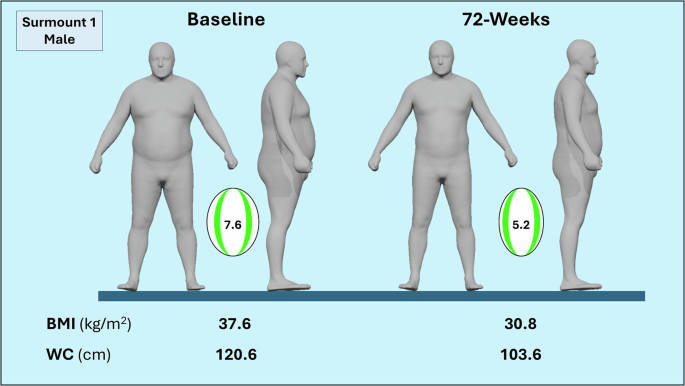
Extending the usual graphical portrayals of longitudinal weight loss drug effects and tabular presentation of health measure improvements [2,3,4,5], the current study presents visual images that capture these kinds of observations in an easy to understand and assimilate format. The presented images provide a sense of what the average male and female participants looked like at baseline, prior to drug treatment, and how they appeared after approximately one year following medication use, along with the extent to which their heath-risks diminished. The average male and female participants in the Surmount 1 study began the protocol with similar baseline BMIs [16], but the female participants lost relatively more weight and had greater health improvements, at least according to BRI, than the male, findings clearly evident from the images shown in Figs. 1, 2. Consistent with the reductions in BRI, cardiovascular disease risk factors improved in Surmount 1, although sex differences could not be ascertained as male and female observations were pooled in the pivotal publication [2]. The avatar-predicted changes in body shape with weight loss also differed between the male and female, the male losing more volume (i.e., mass) from the trunk and less from the legs than the female. As shown by the images, baseline BMIs were quite high (~37–38 kg/m2, Class II obesity) and, as depicted by the avatars, body size and shape remained in the overweight-obese range following 72 weeks of medication treatment.
Are the 3D avatar body size and shape estimates accurate? We validated the manifold regression approach in an earlier study by comparing predicted avatar dimensions to those acquired with a 20-camera 3D-optical system and we found close agreement for evaluated circumferences, volumes, and surface areas [6]. In that cross-sectional study, we also found that avatar predication covariates beyond sex, weight, height, and age were important in refining avatar features. These additional model covariates include measured variables such as circumferences derived from a flexible tape and impedances evaluated with bioimpedance analysis systems. This highlights the importance of collecting and publishing such clinical trial data, which can be used in follow-up studies such as the current report. Accurate 3D avatars, using these types of covariates, could be employed to estimate changes in body composition with weight loss [7, 18], incorporated as a visual supplement when reporting the results generated by dynamic energy balance weight loss prediction models [8], and serve a role as part of human heat thermoregulation models introduced for medical and public health applications [19].
The 3D avatars and health-risk images presented in this report can also potentially serve a useful purpose as part of weight loss treatment plans. Horne et al. [20]. observed that visualizing a future “self” as a personalized avatar reinforced motivation to modify behavior, an effect that might build self-confidence and promote participation in a weight loss program. Further research is needed, however, to examine the psychological effects of exposing people who are overweight and obese to images that emphasize their body size and shape. Individuals categorized as overweight and obese are already at a heighted risk of experiencing negative body image perceptions due to weight stigma and weight bias [21]. The visual tools described herein may draw further attention to aspects of their physical appearance, exacerbating feelings of body dissatisfaction [22]. Moreover, appearance-related motivations for exercise have been linked to disordered eating behaviors and poor adherence to health regimes [23]. When individuals fail to achieve their desired weight loss or appearance goal in the short term, they often abandon behavior change altogether, suggesting that using appearance as the primary driver for health behavior change might be an ineffective strategy [24]. The role of 3D avatars in weight control management thus remains a topic worthy of future study.
The focus of this report was on Surmount 1 (tirzepatide) and an assumption is that weight loss in participants proceeded mainly through caloric restriction. As such, the composition of weight change is anticipated to resemble that of non-pharmacologic measures that promote negative energy balance [25]. What if all or most of the weight loss was fat with sparing of lean tissues such as skeletal muscle? This possibility arises through newer muscle-sparing weight loss medicines [26] or protocols that include intensive protein supplementation and physical activity regimens [27]. How would physical appearance differ from that reported here? Our modeling approach, as reported here, allows for variation in the composition of weight change and generation of avatars with specified body composition. We anticipate forthcoming studies that will present an opportunity to explore these kinds of questions.
The current study and approach has several limitations. Waist circumference measurements were unavailable at the 72-week evaluation and had to be estimated using equations derived as reported in Supplementary Information II. We did not include race or ethnicity as covariates in the manifold regression models as the available Surmount 1 data only included pooled averages for all males and all females in the MTD groups. While we did not include race or ethnicity information when predicting humanoid avatars in the current study, the question arises if adding these kinds of covariates is feasible. Our current manifold regression model sample includes information on participant demographics that we can include in predictions, although increasing model accuracy across diverse samples, cultures, and geographic regions requires larger and more varied development groups. The mean data used in manifold prediction models reflected different sample sizes at baseline and 72-weeks and the sizes of the MTD groups were not reported in the presentation of Chao et al. [16]. Our avatar predictions are founded on the assumption that people in the post-weight loss state have similar anthropometric features to their never-weight loss counterparts, a hypothesis that could be evaluated in future studies by including actual 3D-optical evaluations in the protocol. Lastly, the body regions designated by Universal Software were designed to match those of other methods such as dual-energy X-ray absorptiometry. These kinds of image landmarks are easily moved should different regional estimates be of interest in future studies.
In conclusion, humanoid avatar and health-risk images were generated in the current report to present a visual representation of typically complex graphical and text data characteristic of advanced stage weight loss drug trials. Images such as these encapsulate treatment outcomes in a simple format that is easy to understand, even for people not familiar with the nuances of scientific publications. These images have the potential to serve as additional communicated outcomes of weight loss clinical trials that can be shared with professional and public audiences for educational purposes.
link