


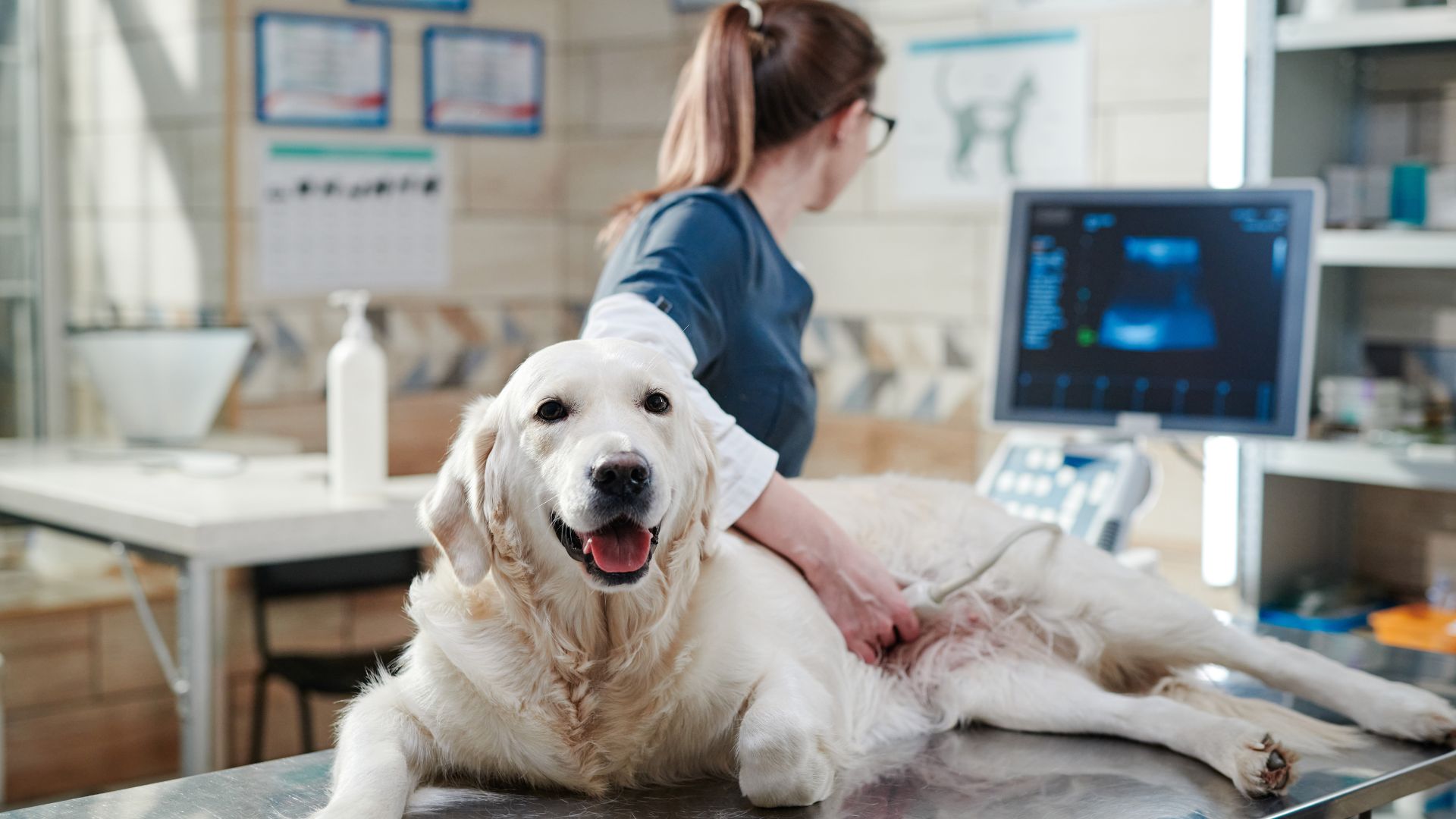
Considering the financial burden of a knee replacement, even with insurance, the decision of whether your best friend, family, or even dog should undergo the surgery can be incredibly difficult.
If the surgery is unsuccessful, the options left may involve severe measures like knee fusion, amputation, or worse. This poses a challenging dilemma for anyone in this situation.
In the United States, pet owners often struggle to decide on the best treatment for their pets’ knee injuries.
A team of five seniors from the Department of Biomedical Engineering at Texas A&M University is working on developing a better option.
“Our project is to create a secondary solution, and to do that, we added a couple more parts to the typical knee implant design,” said team member Cole Mandrona.
“We needed to find a way to allow joints to be held together and still be able to rotate, flex and bend.”
Rev Knee
The student has developed Rev Knee, a specialized process that creates a custom implant for dogs requiring knee revision surgery.
The Rev Knee method begins by uploading CT scans of a knee joint into software that recreates the patient’s unique tibial and femoral components.
“We segment the exact shape of their knee,” team member Sampriti Ramakrishnan said.
“After that, the segmentations are put into an existing software we modified that can customize the patient’s anatomy. From there, we can 3D print a model of their knee.”
Outdated current model
The current knee implant design in the United States relies on the animal’s ligaments for movement and connection to the upper and lower leg bones.
While this approach can provide natural movement and range of motion, it also increases the risk of surgical failure.
“We’re making something that works if you remove all the ligaments because if there’s an initial problem with one or it gets ruined, then that’s the end for that joint,” Mandrona said.
Sponsored by Dr. Brian Saunders, an associate professor at the School of Veterinary Medicine and Biomedical Sciences, the team is part of a partnership initiative between the school and the biomedical engineering department to improve animal and human health outcomes.
The team also sought guidance from industry professionals, including a meeting with DePuy Synthes, an orthopedics company under Johnson and Johnson,” stated Ramakrishnan.
“They do the same customized workflow but for humans, so we were able to learn a lot from them. It was a good experience to talk to people that are actually in industry.”
Although the project prioritizes a solution for canine knee replacements, Dr. Balakrishna Haridas, a professor of practice in the Department of Biomedical Engineering and deputy executive director of the Southwest-Midwest National Pediatric Device Innovation Consortium, suggested that the project could also benefit pediatric patients.
“Our goal is to later translate this for pediatrics,” Ramakrishnan said.
“With pediatrics, you still have to think about how the patient is growing, and we haven’t made that connection yet. There was importance given to the animals first, which is normally not the case, and that feels good.


Stay up-to-date on engineering, tech, space, and science news with The Blueprint.
By clicking sign up, you confirm that you accept this site’s Terms of Use and Privacy Policy
ABOUT THE EDITOR
Kapil Kajal Kapil Kajal is an award-winning journalist with a diverse portfolio spanning defense, politics, technology, crime, environment, human rights, and foreign policy. His work has been featured in publications such as Janes, National Geographic, Al Jazeera, Rest of World, Mongabay, and Nikkei. Kapil holds a dual bachelor’s degree in Electrical, Electronics, and Communication Engineering and a master’s diploma in journalism from the Institute of Journalism and New Media in Bangalore.
link