


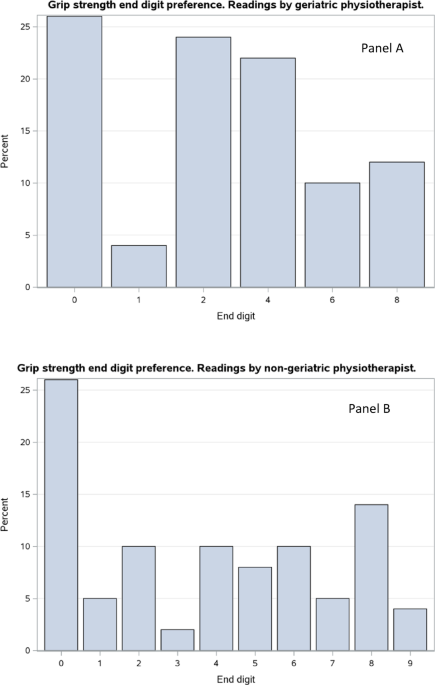
We demonstrate that measurements of grip strength, when obtained from analogue devices, are burdened with end-digit preference. Both the examiners working in the field of geriatrics and those working in other specialties displayed preference towards certain numbers. However, examiners not working in the field of geriatrics had a significantly greater propensity to record odd values, and towards rounding to 5, which are impossible to measure due to the design of the dynamometer display.
There are several possible explanations for the presence of the phenomenon. On one hand, an overzealous attitude towards accuracy may push readers to read odd values, i.e., values between the smallest graduations. On the other hand, fatigue, poor motivation, and lack of proper instruction may result in a tendency to use certain numbers. In our data, non-geriatric physiotherapists tended to read zeroes as last digits and used odd end digits more frequently.
Our data are in line with that from other fields in biomedical research, where cognitive bias, language and cultural factors, habit and routine or misinterpretation of accuracy have been mapped as important contributors to end-digit preference8,9,10. This is relevant as, although, especially in epidemiologic research we tend to use electronic-display devices, in many clinical settings and home use analogue devices might still be prevalent. This may differ from country to country or between regions in the same country.
Another important factor might be associated with lower awareness of the importance of accuracy in a given field, that is especially important in epidemiologic research where even minimal differences in population averages of the phenotypic measurements translate to large differences in outcome measures. Also, one might speculate that in persons with less awareness of geriatric issues negligent measurements may be a sign of ageism, as sometimes the widely held prejudice is that no matter the result it “does not matter in older person”.
Training the examiners to read grip strength values both in clinical and research settings is important. Without it, values obtained may lead to bias in research and clinical decisions.
Recent results demonstrated limited knowledge of sarcopenia, where grip strength assessment is a crucial part of investigation, among non-geriatricians6.
This is important, as the accuracy of the measurement would be reflected in classification of the patient in clinical practice and might affect relations analysed in the framework of the research, especially in clinical trial setting. This will be of special importance in the nearing era of the computer-assisted clinical decision making.
The implementation of validated electronic devices, while opening room for improving accuracy of measurement, will not solve all problems related to reading of the results, as the final accuracy would still depend on rounding. This will in turn be a function of training and scientific and clinical rigour. Monitoring of patient’s status in many chronic diseases moves from hospital or office to patient’s home. The reporting of the results will then depend in part on attitudes of patients towards new technologies. For over five years we have been involved in studies, such as the AAL ‘‘Patient centric solution for smart and sustainable healthcare’’ (ACESO) and the currently ongoing THCS “Reshaping data-driven smart healthcare to optimize resources and personalize care for hypertensive patients through AI and digital twin models” (RENEW), of new technologies in medicine that have been addressing, among other issues, the attitudes of older patients towards new technology11,12. While in our small group of patients we found them to be positive, the answers were far from unanimous, and older patients of different cultural or socioeconomic backgrounds could differ in their opinions.
Clearly, the conclusions we draw from the values of parameters measured in clinical practice are only as valid as the methodology of the measurement and as accurate as the readings obtained.
link